
How Climate Risk Is Reshaping Real Estate — And How ClimateAI Consultancy Can Help

The New Reality: Climate Risk Is Now a Real Estate Risk
For decades, real estate decisions were driven primarily by location, market demand, infrastructure, and economic growth. Today, another factor has become impossible to ignore: climate risk.
From flooding and extreme heat to wildfires, droughts, and severe storms, climate-related events are increasingly affecting property values, investment decisions, insurance costs, regulatory compliance, and long-term asset resilience. What was once considered a sustainability issue has become a critical financial and operational concern for real estate owners, developers, investors, lenders, and asset managers.
As climate risks intensify, organizations that proactively assess and manage these exposures will be better positioned to protect assets, attract investment, and create long-term value.
How Climate Risk Is Transforming the Real Estate Industry
Property Valuations Are Changing
Climate hazards are beginning to influence property valuations across global markets.
Properties located in flood-prone areas, wildfire zones, or regions experiencing extreme weather events may face:
Reduced market demand
Higher maintenance and adaptation costs
Increased financing challenges
Greater long-term depreciation risks
Investors are increasingly incorporating climate exposure into due diligence processes, making climate resilience a key determinant of asset value.
2. Insurance Costs Are Rising
Insurance providers are reassessing risk models in response to increasing climate-related losses.
As a result, many property owners are experiencing:
Higher premiums
Reduced coverage availability
Stricter underwriting requirements
Increased deductibles
In some high-risk regions, insurance affordability has become a significant challenge, directly impacting investment returns and operational costs.
3. Regulatory Expectations Are Increasing
Governments, regulators, and financial institutions are introducing new climate disclosure requirements and sustainability standards.
Real estate companies are increasingly expected to demonstrate:
Climate risk assessments
Physical and transition risk analysis
Resilience planning
ESG reporting compliance
Alignment with frameworks such as TCFD and ISSB
Organizations that fail to address these expectations may face regulatory scrutiny, reputational damage, and reduced access to capital.
4. Investment Decisions Are Becoming Climate-Informed
Institutional investors and lenders are placing greater emphasis on climate resilience when evaluating portfolios and development opportunities.
Key questions now include:
How exposed is the asset to future climate hazards?
How will climate scenarios affect long-term performance?
What adaptation measures are required?
How resilient is the surrounding infrastructure?
Climate intelligence is rapidly becoming an essential component of investment strategy and risk management.
5. Tenant and Occupier Expectations Are Evolving
Businesses and residents increasingly seek properties that offer safety, resilience, and sustainability.
Features such as:
Flood protection measures
Heat-resilient building design
Energy efficiency
Sustainable infrastructure
Emergency preparedness planning
are becoming competitive differentiators that influence occupancy rates and tenant retention.
How ClimateAI Consultancy Supports Real Estate Organisations
At ClimateAI Consultancy, we help real estate stakeholders transform climate uncertainty into actionable intelligence.
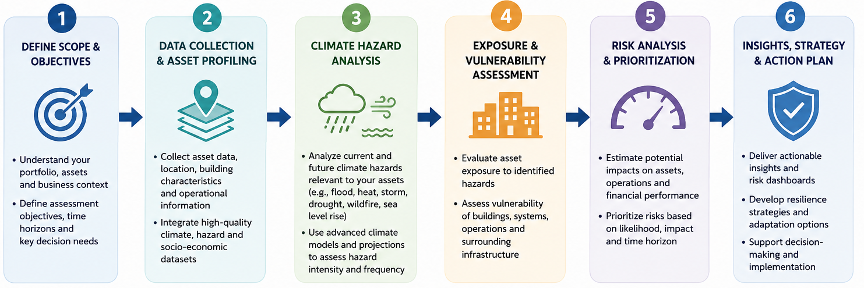
Our climate risk solutions empower developers, investors, property owners, asset managers, and financial institutions to make informed decisions based on future climate conditions.